

Fast Track Colonoscopy: From Referral to Procedure Without the Detour
Colorectal cancer remains one of the most preventable cancers in the United States. Yet it is still one of the most deadly when screening is delayed.
Incidence is rising in younger adults. National guidelines now recommend screening beginning at age 45. At the same time, gastroenterology practices are facing persistent workforce shortages, growing referral volumes, and operational strain. The result is familiar. Backlogs. Unnecessary pre-procedure office visits. Day-of-procedure cancellations. Staff tied up in phone-based intake. Patients who fall through the cracks. What if eligible patients could move from referral to colonoscopy without unnecessary office visits, without manual screening calls, and without compromising safety?
WovenX Fast Track introduces a new standard in colonoscopy access. It is a digital, guideline-based pathway that safely moves appropriate patients directly to procedure while preserving clinical oversight, quality, and alignment with practice-specific protocols. This is not generic open access. It is a configurable, enterprise-ready Fast Track model built specifically for GI practices and health systems.
A simpler, safer path to colonoscopy
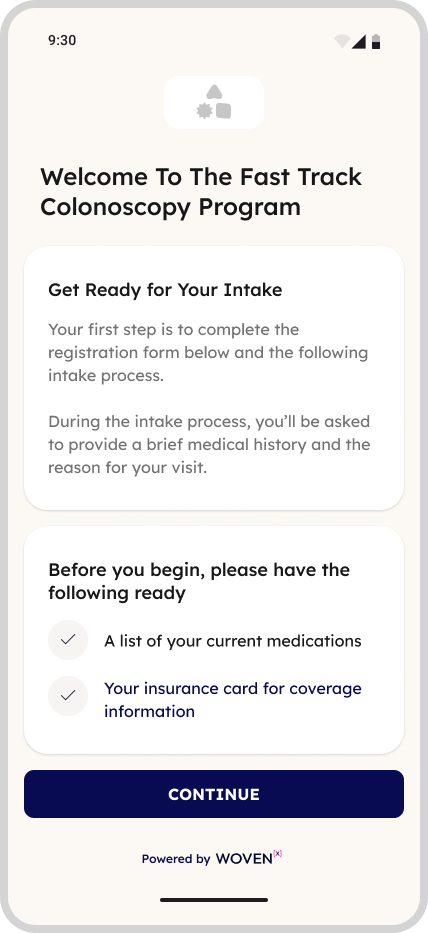
Patients begin on the practice’s website, through a text link, QR code, postcard, or referring PCP workflow. The experience is fully branded and embedded within the organization’s existing ecosystem. They complete a secure Smart Intake that captures:
- Medical history and prior procedures
- Medications, including anticoagulants and GLP-1s
- Comorbidities and surgical background
- Symptoms or red flags
- Logistical barriers that may affect prep or completion
The intake is structured, evidence-based, and aligned with national guidelines as well as ASC- or practice-specific criteria.
The platform evaluates each patient in real time. Those who meet criteria are cleared to move directly to scheduling. Those with elevated risk factors are automatically flagged and routed to a provider visit for further evaluation. No parallel systems. No manual spreadsheets. No fragmented documentation. Unflagged patients proceed confidently to scheduling. Flagged patients receive appropriate review before moving forward. Practices maintain full visibility and control.
Why this matters now
Long wait times in specialty care are not simply inconvenient. Published research has linked delays in care to increased morbidity and mortality risk in preventable and treatable conditions . In GI specifically, prolonged wait times are associated with higher no-show rates and downstream leakage . When patients wait months for evaluation, some delay care entirely.
Others seek care elsewhere. Some never complete screening. Fast Track addresses this structural friction at the top of the funnel.
Instead of:
Referral → Phone tag → Pre-procedure visit → Scheduling → Procedure
Fast Track enables:
Referral → Digital intake → Guideline-based clearance → Direct scheduling
Fewer steps. Less delay. More completed procedures.
Real-world scale: A unified model across multiple practices
A leading mid-Atlantic gastroenterology practice implemented WovenX Fast Track across multiple locations to replace fragmented open access workflows. Prior to adoption, each site used different intake questions and criteria. Screening was phone-based, labor-intensive, and inconsistent. Risk factors were sometimes missed until late in the process, contributing to avoidable cancellations and lost endoscopy time.
After implementing a standardized, digital-first Fast Track model:
- More than 50,000 patient intakes were completed in 2025
- Median completion time was under 10 minutes
- About 35 percent of intakes were completed after hours or on weekends
- 78 percent of patients were cleared to move forward without a pre-procedure visit
Patients completed intake on their own time, including evenings and weekends when phone-based screening would not have been possible. Standardized criteria improved consistency and auditability. A centralized dashboard enabled leadership to compare performance across sites, identify bottlenecks, and replicate high-performing workflows. As one leader noted, every practice had been using open access differently. Fast Track created one approach everyone could rely on. Fast Track replaces fragmented phone workflows with a structured digital intake that:
- Applies evidence-based criteria automatically
- Flags cardiac, surgical, or medication-related risks
- Identifies potential prep barriers early
- Documents decisions in a standardized format
With structured intake and embedded decision support, screenings can be completed by MAs or trained coordinators rather than nurses, freeing clinical staff for higher-acuity tasks. This is not simply a labor-saving measure. It is a quality improvement strategy. Earlier identification of red flags reduces day-of-procedure cancellations. Clear documentation improves alignment with practice standards. Patients arrive better prepared and at the correct location.
Protecting throughput and capturing demand
Screening demand continues to grow. Patients aged 45 to 49 are newly eligible. Employers and payers are emphasizing preventive care. At the same time, ASC capacity is finite. Fast Track supports more predictable procedural pipelines by:
- Clearing appropriate patients quickly
- Reducing unnecessary clinic visits
- Identifying prep or medical barriers early
- Standardizing eligibility criteria across sites
For enterprise groups, consistency becomes a growth lever. With one unified workflow, leadership can finally see where screening decisions are made, how criteria are applied, and where delays occur. Fast Track is configurable to each practice’s protocols and ASC-specific criteria. It does not impose a rigid national template.
Patients move through a branded, consumer-forward experience. Intakes are managed through a centralized platform accessible to the care team. Dashboards track progress, volume, and outcomes across locations. The model aligns with how leading GI groups are already thinking about access, operational efficiency, and quality standardization.
A modern approach to screening access
Colonoscopy is one of the most effective cancer prevention tools in medicine. But its impact depends on timely completion. Fast Track shifts the model from:
Manual, variable, phone-driven screening, to: Digital, guideline-based, data-visible access
It shortens referral-to-procedure timelines. Reduces staff burden. Improves consistency. Protects endoscopy capacity. And most importantly, helps more patients complete appropriate screening without unnecessary friction. This is the shift from fragmented open access to intelligent, enterprise-grade colonoscopy access.
If your organization is looking to simplify screening workflows, reduce avoidable delays, and create a safer, faster path to colonoscopy, reach out here.