

WovenX OnDemand: Care in Minutes, Not Months
Long wait times in specialty care are not just an inconvenience. They are a clinical risk, a growth constraint, and a source of frustration for patients and providers alike.
Across the country, gastroenterology practices face the same structural challenge. Demand continues to rise. Physician supply cannot keep pace. Wait times stretch three to six months in many markets. As delays increase, so do no-shows, leakage to competing groups, and avoidable visits to urgent care and the emergency department.
What if patients could bypass the bottleneck while staying within the practice or health system they already trust, instead of leaking to urgent care, the emergency department, or a competing GI group?
WovenX OnDemand introduces a new standard in GI patient access. It moves patients to the next supervised step within minutes, not months, while keeping them fully embedded in the provider or health system they already know and trust.
This is not generic telehealth. It is OnDemand GI Access, purpose-built for specialty groups.
Care at the speed of need
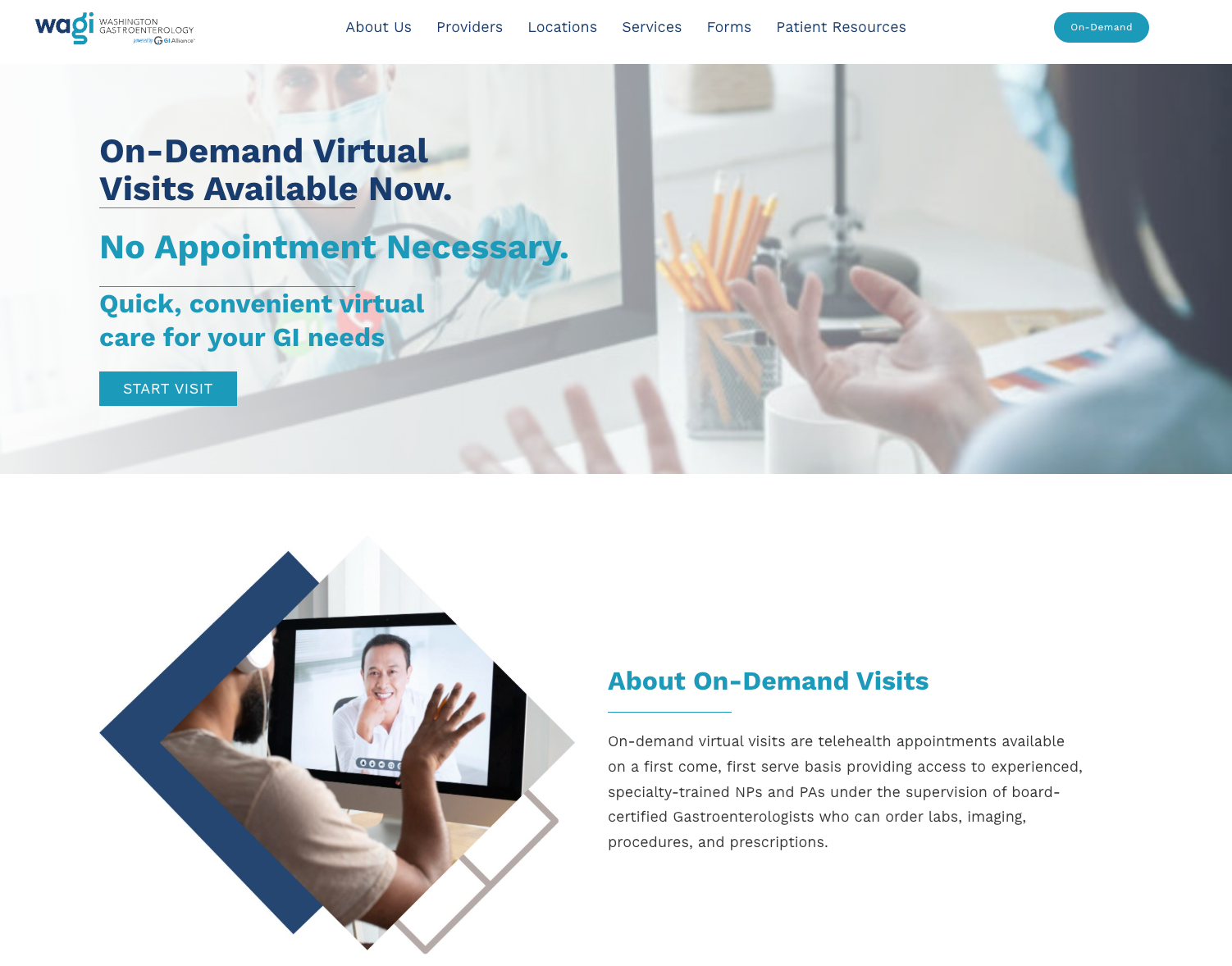
Patients start directly on a GI practice or health system’s website, under that organization’s brand. From there, they complete an AI-enabled Smart Intake that captures symptoms, history, insurance eligibility, and clinical context. The platform applies guideline-based logic in real time, triaging and routing the patient to the next available GI-trained advanced practice provider, typically in under 30 minutes.
Every visit is delivered by experienced, GI-specialized APPs credentialed under the practice or health system’s NPI and supervised by board-certified gastroenterologists. WovenX’s precision supervision model includes AI-assisted review of intake data, APP documentation, and care plans. Complex or out-of-guidelines cases are escalated automatically for physician review.
All documentation, orders, and billing flow directly through the organization’s EMR and revenue cycle infrastructure. There are no parallel systems and no data silos. From the patient’s perspective, the experience remains fully within the provider’s ecosystem, from first touch to procedure.
Faster access, measurable outcomes
impact extends well beyond convenience.
In one independent GI practice, OnDemand patients completed procedures 72 percent faster than patients following the site’s standard process, saving an average of 2.6 months from referral to completed procedure.
More than half of procedures initiated through OnDemand backfilled cancelled endoscopy slots. The result was a measurable increase in endo suite utilization and improved throughput without adding physicians or physical capacity.
OnDemand also attracts a commercially insured, younger population. In pilot data from one partner site, 84 percent of new patients were commercially insured (a 20% uplift from the group’s standard commercially insured mix), with a median age of 43. For practices operating in competitive markets, this represents meaningful top-of-funnel growth.
Capturing demand before it leaks
A critical question in specialty care is whether on-demand access simply reshuffles existing visits. The data suggests otherwise.
When surveyed, patients reported that without OnDemand:
- 41 percent would have considered the emergency department or urgent care
- 35 percent would have returned to their primary care provider
- 28 percent would have looked for another GI practice
These are not rescheduled appointments. They are patients who would have exited the system entirely or sought care elsewhere. OnDemand captures incremental demand and keeps patients within their chosen care pathway.
Optimizing physician time and reducing burnout
Specialty care models are strained in part because physicians are asked to manage everything, from routine follow-ups to complex procedures.
OnDemand shifts appropriate, guideline-based visits to GI-trained APPs in real time. Physicians are able to focus on advanced diagnostics, procedures, and high-acuity care. High-touch patients who might otherwise generate uncompensated portal messages or ad hoc calls are seen promptly in a structured, billable visit.
In practices using OnDemand, just 11 percent of patients accounted for 22 percent of visit volume. Redirecting this demand through a supervised virtual model reduced strain on physicians while maintaining quality.
Integrated, not disruptive
OnDemand is fully white-labeled and embedded within existing workflows. APPs are credentialed under the organization’s NPI. Billing flows through the existing system. Orders are placed directly in the EMR. Call centers can route urgent needs to OnDemand as a same-day option.
There is no manual scheduling infrastructure required. The platform dynamically matches the next available GI-trained APP with the next patient in queue, while ensuring patients remain in the system they selected.
Once implemented, OnDemand becomes a flywheel. It surfaces unmet demand, reduces leakage, fills unused procedural capacity, and accelerates the time from referral to treatment.
“I LOVE that you have on demand video visits. It’s the reason I chose you and the reason I will stick with you.”
This is the shift from reactive scheduling to intelligent, consumer-forward access. From months of delay to minutes of action. From bottleneck to growth engine.
OnDemand does not replace a practice. It extends it with precision, supervision, and measurable results.
To learn more about adding OnDemand to your practice, reach out here.